Sunday, 11 January 2015

Film Breakdowns - Reservoir Dogs (1992)

Film Breakdowns - Reservoir Dogs (1992)

To become the best, we have to learn from the best.

Reservoir Dogs os one of those amazing movies that you quote and watch again and again. It's the story about a group of gangsters after a robbery goes wrong as they regroup and try to figure out which one of them is an undercover cop.

Taratino did a great job on this film and is a great precursor to the amazing Pulp Fiction to soon come after.

Let's begin breaking down my favourite frames from the film that encapsulate That I feel are some of the pivotal points of importance in the story.

Let's get started!

The opening of this film starts with Mr Orange, the youthful and kid-like gangster bleeding out in the back seat. Later we learn he is the undercover cop so in this first scene, he has started paying the price for what he does to keep cover. He is being punished for betraying a soon to be loyal friend and learns the criminal life is a harsh one.
When both men get back to the safehouse, Mr White is shown down this long corridor, isolated from all existence seemingly in this Barron warehouse. He is alone because the cops knew about the robbery, they were caught off guard and he is coming to terms that one of this fellow gangsters is an undercover cop. The unknown is an anchor pulling him down.
When more people show up at the warehouse the thing to notice is how everyone is in different places. No one stands by anyone else. No one trusts anyone else and everyone is watching their own backs. The framing shows isolation despite being near people who are supposed to be friends.
I find it interesting that Mr Blond is sitting on a file of boxes in the warehouse because his body language and how he acts reminds me of a child sitting on a table top, kicking his legs because he can't touch the floor. He is the childish one of the group but also the most psychopathic. having him sit on here shows his need to be king of the castle. A good subtle bit of storytelling.
Here, Mr Blond is setting a line of gasoline because he is about to set fire to the captured cop alive. The plot has hit a dead spot where nothing has happened so Mr Blond kick-starts this with a literal catalyst. The attempted burning of the man forces Mr Orange, the real undercover cop to shoot him and break cover.
Finally showing some element of control over what's happened, Mr Orange has literally had a death and rebirth moment where he has transcended who he was and began to become the man he needs to be. Despite bleeding out, he saves the life of another cop and breaks cover to uphold his sense of a moral compass.
Blatantly impersonating that famous scene in the mirror from Taxi Driver, he shows off his kid like personality. This contrasts with when he reveals who he is and kills Mr Blond. Mr Blond represents a lack of empathy and someone with no moral compass towards killing and while Mr Orange killed a lady to stay under cover, he rejects the Mr Blond within by shooting him.
The final sequence of the film sees everyone shooting everyone. No one survives and they all suffer for their sins. Even the cop dies despite doing nothing wrong. That's because Tarantino is telling us that there won't always be a happy ending. The criminal world is a ruthless one in which anyone can get burned and consumed. That crime doesn't pay. It kills you inside or literally leads to your death.

I love this move so much, I don't know how many times I've seen it and watching it again to get these screen-shots was more than enjoyable. It's hard to decide which I prefer more, Reservoir Dogs or Pulp Fiction because they're so good, so I will leave it here saying you must see it if you haven't.


Film Breakdowns - Blood Simple (1984)

Film Breakdowns - Blood Simple (1984)

To become the best, we have to learn from the best.

Blood Simple is an amazing film by the Coen brothers about a man, his girlfriend, her disgruntled ex lover and a contract hit man in their deadly dance of death that leads to burying a body killed by someone else. Fantastic visuals and great storytelling.

Let's begin breaking down my favourite frames from the film that encapsulate what I feel are some of the pivotal points of importance in the story.

Let's get started!


 The opening shot of this movie is a conversation conducted behind two people, we don't even see their faces. The windshield is being pelted with rain and it's dark and moody. A storm is coming is what that tells me. These people, why don't we see them? Why shoot them from behind? Because we don't need to. Why? I haven't figured that out yet myself.
As the man comes in the house we get two circuital pieces of information. First, he strokes the dog meaning he's a kind man at heart with a fondness for comfort and companionship. Secondly, he asks if the dog bites, meaning it is not his house and he hasn't been there before. He is a kind man and in a house he perhaps shouldn't be in.
As she sleeps, the shadows quite literally eat her alive, leaving her half in shadow and half in light. It is a representation of her state of mind at this point. She feels threatened and alone and more importantly, she feels fear. The biggest thing on her mind is fear, as the shadows of her mind begin to take over. She is in equilibrium and must fight for herself.
 
Our contract hitman/theif (whatever he's asked to do) is shown here with a blue key on his face. It is dark and moody, showing us he is not a nice man nor someone you want to have around you. The blue to me suggests being cold. A cold blooded man with no concious and no sense of morality past getting paid. He even enjoys himself by the looks of things.
After the jealous ex lover is killed by the man he hired to kill her, he is left here in his place of death. He is alone, a small man with nothing left. He lost it all and in his bitter resentment, he even lost his life. This is a man who has fell prey to the darker side of human nature and has paid the ultimate price of dying sad and alone.
 In this magnificent room, we have a natural divide in the middle made by the chimney on the furnace/heater (whatever it is). The two people being on opposite sides of the divide who us they are different to each other. He buried and ultimately killed her ex lover but thinks she shot him which she didn't. Their secrets are incompatible. They cannot be together.
When the man is shot, the cross-hairs on the sniper scope aim at the woman. In good films, everything has multiple meanings. Nothing is ever just in general. These cross-hairs are a symbol of the hit man's wrath. He is coming for her, whether he hits her or not, she is now his target. She must overcome her final ordeal.
After outwitting the killer and sticking a knife into his hand, pinning him to the window ledge, he shoots through the wall. This is his last attempt (or so it seems) at his own sense of freedom. The villain has one last move in his bag of tricks and the hero has to die and be reborn to grasp the elixer and finish the story having gained something valuable.

Blood Simple is a marvel of a film and stands to show that all you need to make an incredible movie is a good script, lights, a camera, sound, good actors and the props and locations to pull it off. No visual effects, no 3D, nothing but good film making.


Film Breakdowns - Vertigo (1958)

Film Breakdowns - Vertigo (1958)

To become the best, we have to learn from the best.

Vertigo is all about the struggle of a detective who suffers from vertigo after almost falling to his death, as he tries to solve the mystery of a woman supposedly possessed by a dead woman.

Alfred Hitchcock directed this fine film and it holds on of my favourite movie lines ever: "you know I've got vertigo!"

Let's begin breaking down my favourite frames from the film that encapsulate what I think are some of the pivotal points of importance in the story.

Let's get started!

The opening sequence as per Hitchcock style is very layered in the meanings you can take away from it. To me, this means that the story revolves around danger and blood on someone's hands. It relies around vision, that is, the perception of things. It is about a search for something both internal and external.
Here is one of the first times we are introduced to the leading lady in the film and she is framed in between two door frames. Could this be because she is being spied on by the hero? Does it mean she is never free because eyes are on her? Or does it mean she has something holding her down like chains on a ghost in limbo?
Here we get this beautiful aerial shot of the staircase. The stairs are winding and look like a maze. This isn't so much an excuse to play on the heroes vertigo condition (revealed later) but I think it is to represent his state of mind. Since almost dying, his mind is a labyrinth which he cannot climb nor navigate. It will take death and rebirth before he can conquer this maze.
When we see the detective later meet up with a woman who looks eerily similar to the woman who fell from the roof, we see them in this mirror shot. Notice how she is the only one being reflected in the mirror. I think this is because she isn't looking at herself in the mirror, she is envisioning who she wants to be and who she could become.
 The loneliness of our hero is more than obvious as he is seen here in this baron and gigantic room which is completely devoid of life and appeal to the eye. This room is our heroes heart: Beaten up, ugly, worn out and completely empty. The framing just emphasises this.
That moment when you realise how everything fits together. The detective has been in and out of the dark from the beginning of the film but now he finally has all of the pieces in the right place. She is trying to kiss him, a way to show her newly acquired love for him, desperately trying to make amends for her sins. He is looking the other way, he has seen through her.
Now the roles have switched. The hero has everything in place. He has beaten heartbreak, temporary insanity, near death and emotional turmoil and finally seen through all the lies and figured out the mystery. She no longer represents herself to him, she is his inner neuroses and he is choking them, destroying his demons and reclaiming the throne of power in his mind. 
The final shot of the film as the woman has essentially thrown herself off of the tower. Movie justice is fulfilled. She aided in murder and broke our heroes heart, she must die. He is damaged from this ordeal, a man in a darkened archway of a heart, however, he has died and been reborn. He has eliminated his fears and been resurrected.

Vertigo is one of those films that has so much in it but seems to be so simply presented that you could watch it as a film maker, analysing every move made and the progression of the story or casually watch as a normal viewer. It can be about a detective in love overcoming a fear of heights or it can be about a man on a journey to destroy the demons that hold the key to the labyrinth of his mind and the woman's journey to find love and a place to belong after being used as a tool for murder. 


Film Breakdowns - Goodfellas (1990)

Film Breakdowns - Goodfellas (1990)

To become the best, we have to learn from the best.

Goodfellas is the story of a young man who ends up working for the Mafia. He becomes one of the family with the mobsters and finds the love of a girl but things take a turn for the worse when he gets addicted to drugs, a high profile gangster gets killed and they fail to lay low after a huge robbery.

Let's begin breaking down some of my favourite frames from the film which encapsulate what I think are some of the pivotal points of importance in the story.

 Let's begin!

The opening sequence sees our sort of hero if you can call him a hero lighting a rag in a bottle and using it to set a car on fire. This is not just some cool opening explosion, this represents him putting his chance of a normal life behind him, he has crossed the threshold of no return and is now baptised in the chaos of the explosion.
 What's happening here? A mound of dirt with people digging? Red lights? Mist? Without seeing the scene you could have a pretty good guess. Someone has been murdered and they're digging a grave. The lights are the car head lights and red, well red is the colour of danger, blood, passion and anger. It represents the blood on their hands.
After someone harasses the woman our sort of hero likes, he battered him with a gun and then gives it to her to hide. This looking at the gun is highly significant. She isn't looking at a gun, she is looking at the danger of her relationship with him. She is looking at a more exciting future and contemplating whether to cross the threshold.
 There is always a refusal by the central figures at one point or another to carry on with their own story. In the film she is pointing the gun at his face when he is in bed. I don't think this is what Scorsese meant in such simple terms. I think he wanted her character to point the gun at the audience to say, "I don't belong in this story, get me out, now."
Having been in on the robbery and gone against their word of not spending any, they get what they deserve. We don't like by the morals of society in this film, we live by the code of the criminals. Loyalty reigns supreme so their act is a major sin. Bloodied in their car they bought with that money and confined in an environment cage of the window.
This shot you have to watch yourself to get the full impact of how brilliant it is. The scene starts out on a wide lens with the camera close to them. As they talk, the camera dolly's back and the camera zooms in. The background creeps in, just as the pressure on both men is creeping in. The world around them is contracting and they know it.
Tommy is killed because he killed a high profile gangster who he shouldn't have killed. He has been made an example of. Just as how in a medical theatre students would watch from up high as they cut up cadavers, this shot says to me, "look at what happens when you kill the wrong guy. Look what this life has given you." 


Goodfellas is and probably will stay my all time favourite gangster film. Pulp fiction and Reservoir Dogs come in very close but this film, from it's incredible cinematography, storyline, characters and the always immense work by Martin Scorsese, this film is my tippy top of all gangster flicks. Below is the diner shot, so you can see just how amazing it looks in the film. 


Saturday, 10 January 2015

Film Breakdowns - Touch of Evil (1958)

Film Breakdowns - Touch of Evil (1958)

To become the best, we have to learn from the best.

Touch of Evil is the fantastic story of a highly respected cop being accused of fixing evidence and getting false convictions and a Mexican cop's journey to expose him.

Of course there is a woman, a murder, a conversation conducted through a mirror and a journey of unravelling the crime.

Let's begin breaking down my favourite frames from the film that encapsulate what I think are some of the pivotal points of importance in the story. 

Let's get started!
The ticking time bomb, used in quite the literal sense as the opening shows us from the start that the theme of the film is about time running out. For the most part, it is about time running out for the detectives secrets of false convictions and planted evidence. It's about secrets exploding when they run their course.
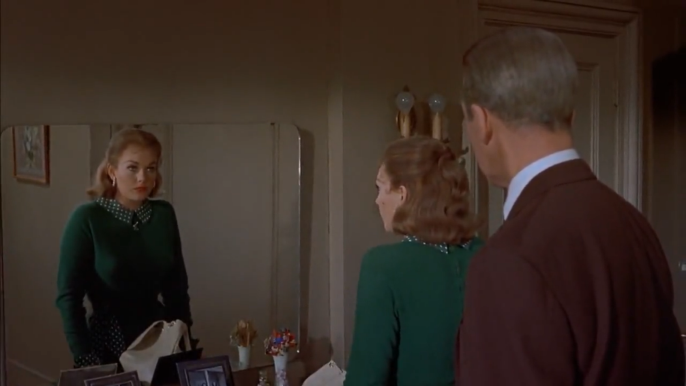
The classic conversation through a mirror convention that has been re-used and re-invented time and time again. This one shows the man in an incredibly dominant state as we see him twice, he is taking up half of the frame and she is standing behind him. She looks small and is small at this point.
As the detective walks through the area we see him walking behind these cross shaped supports. A nice subtle touch as you don't notice it too much but once again it is a good example of an environmental cage that frames the characters with something to hide.
The Mexican detective is being literally singled out at this point. His difference of morals to that of the corrupted detective with a shady practice to hide is hinted at in this frame. He is shown in this frame of the door, singled out in the frame and tiny in relation to the other two.
Like in Notorious, a conversation is carried out that we cannot see. The director could have had a cut away of the conversation but it's more effective that we, like her don't see it. We then share her anxiety of the unknown. It makes us ask questions and fearful of what might happen next.
Like the reaper himself creeping into the room, the lighting is dark and ominous as the shadow floats into the frame. The murderer who we do not see (making us ask questions) is the symbol of death and chaos. He represents the death of morality and innocence as an innocent man is murdered for selfish reasons.
The Mexican detective is onto the corrupt detective. Is there any better way to show the impending clash of two equally matched adversaries about to chase each other to the victor is revealed? The head of the game representing the hunter and prey mentality the detective has now. We know, a war is about to happen.


The corrupt detective who maintained at least some element of concious, all-be-it a minuscule amount has committed fully to the darkness of his heart and shot his friend. His world is turned on its head and distorted by his selfish need to keep his reputation over what's right. Shown here by the unusual low slanted angle.

I adore this film and it is an absolute marvel at the potential of cinematic storytelling. The opening scene alone is a single shot that spends minutes craning, swooping, moving, tilting, panning and moving in and out and around scenery. It it a dynamic and beautiful film that deals with a great tragedy of the human condition: loosing oneself in arrogance and reputation and committing to darkness. It is a slipper road from which only death and rebirth can save you. This film shows that fantastically. 


Film Breakdowns - Kiss Me Deadly (1955)

Film Breakdowns - Kiss Me Deadly (1955)

To become the best, we have to learn from the best.


Kiss Me Deadly is all about a man trying to make heads or tails of a strange situation with a mysterious box, a girl he almost runs over and a group of people who will kill to get her and it.

One of the more stranger films as it doesn't stick to the strict rules of the world we live in. 


Let's begin breaking down my favourite frames from the film that encapsulate what I think are some of the pivotal points of importance in the story.

Let's get started!

The first time we see the female lead in the film and she is throwing herself in front of a car. The absolute desperation you must be feeling to need to risk your life just to get attention and be rescued from where you are. It sums up the character of the woman perfectly. She is someone running from something, driven by desperation.
I absolutely adore shots like this. Who is dead? Are they dead? Who are those men? Did they kill her? What did she do? This looks like a killing after an interrogation, what do they want with her? What information did she not give them that would cause her death? Did she tell them and the info was so huge she had to die?
The loyal friend of our hero is shown here through the window of the car and through a second window. He is a good man, helping our hero in his times of need but for this, he is damned for meddling in the battle between hero and villain. It foreshadows his coming death.
In this frame we can see our hero being followed by a men behind him. He stops off at various places on his walk to stop and take up some time while secretly keeping an eye on his follower. Here, the man is literally over his shoulder and he represents the antagonist figure in the film closing in and adding pressure.
The bars on the bed being in the close foreground are a nice touch to give another environment cage. The theme of captivity and lack of freedom are a constant theme in many film noir. The gun pointing at the door with the light above look gorgeous; it's very lovely framing.
The antagonist is closing in on her and the pressure is high. She is very nervous and incredibly anxious. This is shown with such elegance in this shot. With the banister blacked out in the foreground it's like we the audience are spying on her. This high angle makes her seem like an ant. She is powerless and she knows it.
He's tied to the bed? And is this the antagonist of the film? Is that why we are denied seeing his face? What is he doing? Have we see him before? Frames like this make us ask a myriad of questions that challenge the audiences understanding of the scene and make us feel apart of the mystery.
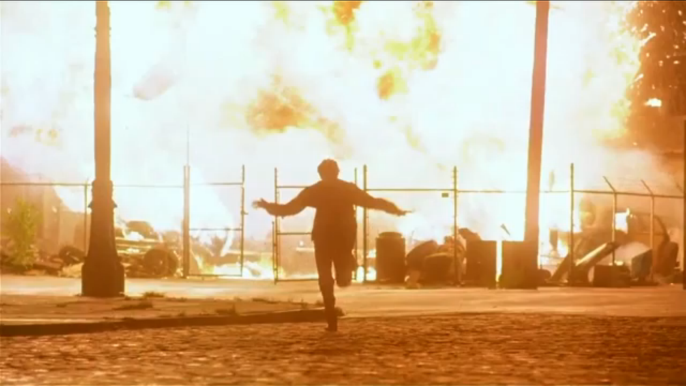
The final escape from the burning/exploding hut on the beach as they limp away from the final ordeal battered but alive. They have accomplished a daring feat of resisting the temptations of power and have been granted a new life, they are reborn a new and resurrected from the ashes. Like the frame, they start on a new path of unknown length and new experiences

This was one of the stranger film noir's I have seen in that it includes supernatural powers. We never find out what's in that box but by the looks of how it all ends, if it wasn't Pandora's box then I don't know what it could have been. A good film with twists, turns, mysteries, audience involvement and a good ending. Watch it, it's a pretty cool film!